
Knee replacement, also known as total knee arthroplasty, is one of the most common elective surgical procedures performed each year in the United States. Chances are good that you, or someone you know, has had or is considering a knee replacement. Even though knee replacement is very common, many people don’t understand what really happens during the procedure. This guide will help explain what knee replacement is—and what it isn’t.
Understanding What “Replacement” Really Means
The name “knee replacement” can be confusing or misleading. We don’t actually replace everything in and around the knee joint. Instead, we fix the damaged parts. Most people need this surgery because arthritis has damaged the articular cartilage. This cartilage is the smooth, nearly frictionless surface that lines the ends of the bones where they meet, allowing them to move easily against one another.
What Happens During Knee Replacement Surgery
Knee replacement is more like a resurfacing of your knee. Here’s what your surgeon will do during surgery:
- Remove Damaged Parts Your surgeon carefully cuts away thin layers of damaged cartilage and bone from the ends of your bones.
- Add New Surfaces The fresh bone surfaces are covered with metal caps called implants. The shin bone typically gets a titanium cap. The thigh bone gets a cap made from cobalt-chromium alloy. This metal does contain nickel, so tell your doctor if you have a nickel allergy.
- Create Smooth Movement Between the two metal caps, your surgeon places a strong plastic insert. This plastic is called highly cross-linked polyethylene. It creates a smooth surface where metal slides against plastic. This lets you move your knee and put weight on it.
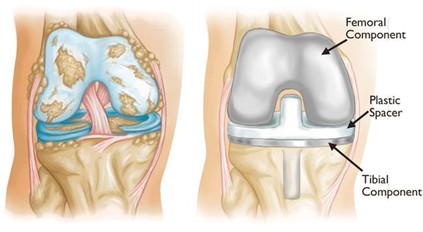
Source: https://orthoinfo.aaos.org/en/treatment/total-knee-replacement/
What Gets Removed and What Stays
During knee replacement surgery, your surgeon will remove some parts and keep others.
Parts That Are Removed:
- The menisci (the cushions inside your knee)
- The ACL (anterior cruciate ligament)
- Sometimes the PCL (posterior cruciate ligament)
Don’t worry, removing these parts is part of the plan. Your new knee will still work well without them.
Parts That Stay:
- Ligaments on the sides of your knee
- Tendons across the front of your knee
- Most or all of your kneecap
These parts are very important. They help keep your knee stable and working properly. However, because they stay in place, they can sometimes still cause pain after surgery.
Setting Realistic Expectations After Knee Replacement
Knee replacement works very well for reducing pain, but it’s important to understand the functional goals of this surgery. Most patients can reliably return to low-impact activities such as walking, hiking, stationary biking, cycling, ellipticals. Lower-demand sports like doubles tennis and pickleball can also be in the mix.
However, a replaced knee is not a normal knee. It will not feel the way your knee did in your twenties before any pain or injury. Outcomes are less predictable for high-impact, repetitive, activities with lots of jumping, quick turns, or sudden stops. I caution patients that they may not like how the knee feels during sports such as skiing, singles tennis, basketball, judo, or similar activities.
Different surgeons have different rules about activity restriction after surgery. My approach is simple: you can do any activity that feels comfortable and safe for you.
The Bottom Line
Knee replacement can greatly improve your quality of life by reducing pain and helping you stay active. Understanding what the surgery involves, what it can and cannot do, and what to expect after surgery will help you make the best decision for your health.