
Cirrhosis of the Liver
Cirrhosis is the eleventh-leading cause of death by disease in the U.S. About 25,000 people die from the complications of cirrhosis each year; almost half of these are alcohol related. There also is a great toll in terms of human suffering, hospital costs, and the loss of work by people with cirrhosis.
Causes
Cirrhosis has many causes. It can result from direct injury to the liver cells (such as from hepatitis) or from indirect injury via inflammation or obstruction of the bile ducts, which drain the liver cells of bile.
Common causes of direct liver injury include:
- Chronic alcohol use (most common cause in the U.S.)
- Chronic viral hepatitis (types B, C, and D)
- Autoimmune hepatitis (AIH)
Common causes of indirect injury by way of bile duct damage include:
- Primary biliary cirrhosis (PBC): the liver’s bile ducts are slowly destroyed
- Primary sclerosing cholangitis (PSC): bile ducts inside and outside the liver become inflamed and scarred
- Biliary atresia: injury and loss (atresia) of the bile ducts that are responsible for draining bile from the liver; affects newborn infants
Less common causes of cirrhosis include:
- Direct liver injury from inherited disease such as cystic fibrosis
- Alpha-1-antitrypsin deficiency
- Galactosemia and glycogen storage diseases
Two inherited disorders result in the abnormal storage of metals in the liver leading to tissue damage and cirrhosis:
- Wilson’s disease: patients store too much copper in the liver, brain, kidneys, and corneas of the eyes
- Hemochromatosis: too much iron is absorbed, and the excess iron is deposited in the liver and other organs, such as the pancreas, skin, intestinal lining, heart, and endocrine glands
Very rare causes of cirrhosis include reactions to drugs (e.g., vitamin A, Dilantin, methotrexate, amiodarone), exposure to environmental toxins, and repeated bouts of heart failure with liver congestion.
If the cause of cirrhosis is still not clear after a full evaluation, it is termed “cryptogenic cirrhosis.” As many as 10 percent of patients with cirrhosis fall into this category.
Bile Duct Blockage
If a person’s bile duct becomes blocked, this also may cause cirrhosis. The bile ducts carry bile produced in the liver to the intestines, where it helps digest fat. In babies, the most common cause of cirrhosis due to blocked bile ducts is a disease called biliary atresia. In this case, the bile ducts are absent or injured, causing bile to back up in the liver. These babies are jaundiced (yellow skin) after their first month of life. Sometimes they can be helped by surgery, in which a new duct is formed to allow bile to drain again from the liver, or they may require a liver transplant.
In adults, the bile ducts may become inflamed, blocked and scarred due to another liver disease, primary biliary cirrhosis (PBC). Another type of biliary cirrhosis may also occur after a patient has gallbladder surgery in which the bile ducts are injured or tied off.
Obesity
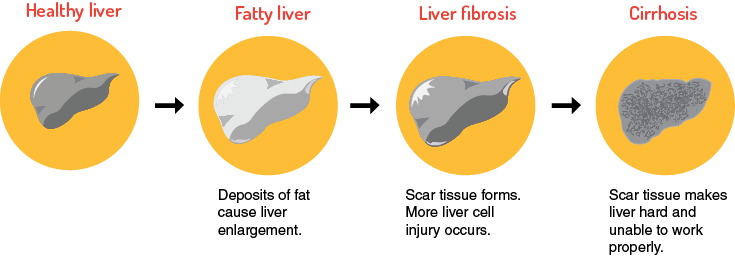
As the incidence of obesity continues to rise, liver disease that may lead to cirrhosis, such as metabolic dysfunction-associated steatotic liver disease (MASLD) and metabolic dysfunction-associated steatohepatitis (MASH), may become more prevalent. These diseases resemble alcohol liver disease, but occur in people who drink little to no alcohol. Patients with MASLD have fatty livers without inflammation or damage, which may not produce any symptoms. MASH involves the accumulation of fat in the liver cells as well as inflammation of the liver, which can destroy the liver cells and lead to irreversible scar tissue and cirrhosis.
Symptoms
Patients with cirrhosis often have few symptoms at first. The two major problems that eventually cause symptoms are the loss of functioning liver cells and distortion of the liver due to scarring. Patients may experience:
- Fatigue
- Weakness
- Exhaustion
- Loss of appetite, often with nausea and weight loss
- Menstrual abnormalities (absent or infrequent periods not related to menopause)
- Impotence, loss of sexual drive, or tender, enlarged breasts called gynecomastia that occurs mainly in men
As liver function declines, less protein is made by the organ. For example, decreased albumin production can result in water accumulating in the legs (edema) or abdomen (ascites). A decrease in proteins needed for blood clotting makes it easy for the person to bruise or bleed.
Late Stage or Advanced Cirrhosis
In the later stages of cirrhosis, jaundice (yellowing of the skin) may occur, caused by the buildup of bile pigment normally secreted by the liver into the intestines. Some people with cirrhosis experience intense itching due to bile products that are deposited in the skin. Gallstones often form in persons with cirrhosis because not enough bile reaches the gallbladder.
Patients with advanced cirrhosis have difficulty digesting certain proteins that result in toxic levels of ammonia in the blood. This condition is termed “hepatic encephalopathy” and can lead to symptoms that range from mild sleep disturbances and difficulty concentrating to unresponsiveness and coma. Many drugs are filtered by the liver, but this process can be slowed down by cirrhosis. Because the liver may not remove the drugs from the blood at the usual rate, a drug may act longer than expected. This is especially true of medications that may be sedating. People with cirrhosis are often very sensitive to medications and their side effects.
A serious problem for people with cirrhosis is an increase in pressure in the blood vessels that flow to the liver. Normally, blood from the intestines and spleen is pumped to the liver through the portal vein. But in cirrhosis, this normal blood flow is slowed, increasing pressure in the portal vein (portal hypertension). This blocks the normal flow of blood, leading to the spleen enlarging. The blood is frequently “shunted” around the liver to return to the heart by smaller collateral vessels, which may become enlarged. In the stomach and esophagus, these engorged blood vessels are termed “varices” and are at increased risk of bleeding, which is another major complication of cirrhosis.
Diagnosing Cirrhosis
Cirrhosis is diagnosed by a variety of measures, including laboratory tests, physical exam, imaging studies (ultrasound, CT scan, or MRI), and, in some cases, a liver biopsy. The standard approach for liver biopsy is performed by passing a very thin needle directly through the skin and body wall and into the liver to take a sample of tissue. In patients who have high bleeding risk, a transjugular approach is favored, where a thin needle catheter is passed into a vein to reach the liver.
Treatments
The treatment of cirrhosis is aimed at stopping or delaying the progression and reducing complications. In alcohol-associated cirrhosis, for instance, the person must stop drinking alcohol to halt the progression of the disease. If a person has hepatitis, the doctor may administer steroids or antiviral drugs to reduce liver cell injury.
Good nutrition is key to managing advanced cirrhosis. Diets which include “easy to digest” forms of protein, such as legumes, poultry, and fish, are important, as is a low-sodium diet in patients with edema or ascites, the buildup of fluid in the legs or abdomen.
General measures recommended in patients with cirrhosis should include vaccination for hepatitis A, B, and annual influenza, as any of these diseases, if acquired, can result in significant sickness and death. Patients should be advised against eating raw seafood and should question their physician when taking any prescription or non-prescription medication (e.g., acetaminophen or supplements).
Medications may be given to control the symptoms of cirrhosis, such as itching. Edema and ascites are treated by low-sodium diets and water pills called diuretics, which increase urine output to remove excess fluid and prevent edema from recurring.
Diet and drug therapies can help improve the altered mental function that cirrhosis can cause. For instance, decreasing ‘difficult to digest’ dietary protein, such as red meat, results in less toxin formation in the digestive tract. Laxatives may be given to help decrease the absorption of toxins and speed up their removal from the intestines.